How to Identify German Articles Easily (der, die, das Guide)
How to Identify German Articles Easily (der, die, das): A Practical Guide for Beginners
Learning German becomes much easier once you understand how articles work. One of the first challenges every learner faces is figuring out whether a noun takes der, die, or das. Unlike English, German assigns a grammatical gender to every noun, and there’s no universal rule that works for every word.
The good news is that you don’t need to memorize thousands of nouns randomly. By learning common patterns, endings, and practical techniques, you can identify German articles much more easily and improve your speaking, reading, and writing.
In this guide, you’ll learn simple tricks, useful rules, and memory techniques that make identifying German articles much less confusing.
What Are German Articles?
German has three definite articles:
| Article | Gender | English Equivalent |
|---|---|---|
| der | Masculine | the |
| die | Feminine | the |
| das | Neuter | the |
Examples:
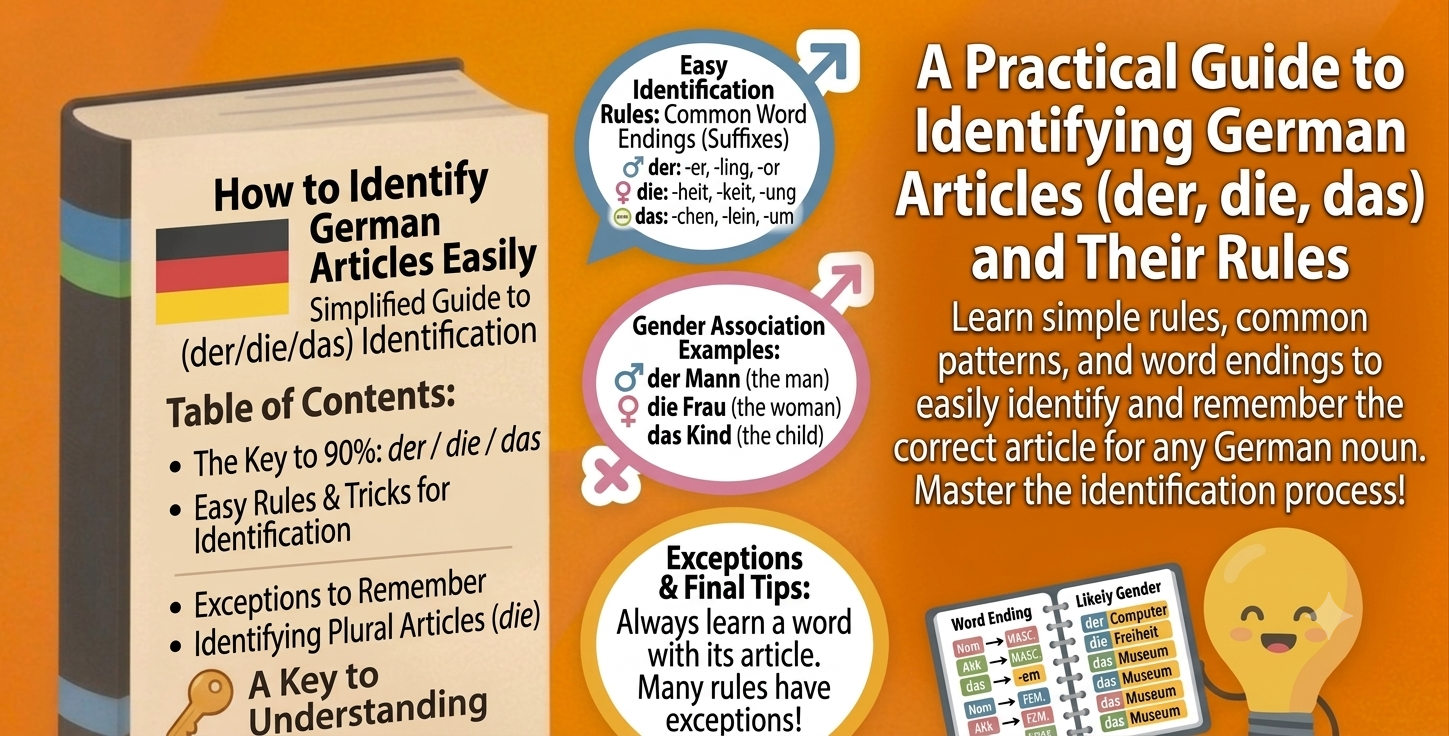
- der Mann (the man)
- die Frau (the woman)
- das Kind (the child)
Unlike English, the article changes depending on the noun’s grammatical gender.
Read More About : German Articles
Why Are German Articles Important?
Using the correct article is essential because it affects:
- Sentence structure
- Adjective endings
- Pronouns
- Cases (Nominative, Accusative, Dative, Genitive)
For example:
- Der Hund schläft.
- Ich sehe den Hund.
The article changes depending on the grammatical case, making it important to know the noun’s gender from the beginning.
The Three German Genders Explained
German nouns belong to one of three genders:
Masculine (der)
Usually refers to:
- Male people
- Days
- Months
- Seasons
- Most weather terms
Examples:
- der Vater
- der Montag
- der Sommer
- der Regen
Feminine (die)
Often includes:
- Female people
- Most flowers
- Many trees
- Numbers used as nouns
Examples:
- die Mutter
- die Rose
- die Birke
- die Eins
Neuter (das)
Common for:
- Young people and animals
- Many metals
- Hotels
- Languages
Examples:
- das Kind
- das Kalb
- das Gold
- das Deutsch
Learn the Most Reliable Word Endings
The easiest way to identify articles is by recognizing noun endings.
Masculine Endings (Usually der)
| Ending | Example |
|---|---|
| -er | der Computer |
| -ling | der Schmetterling |
| -ismus | der Tourismus |
| -ig | der Honig |
Examples:
- der Lehrer
- der König
- der Frühling
Feminine Endings (Usually die)
These endings are highly reliable.
| Ending | Example |
|---|---|
| -ung | die Zeitung |
| -heit | die Freiheit |
| -keit | die Möglichkeit |
| -schaft | die Freundschaft |
| -ei | die Bäckerei |
| -ion | die Nation |
| -tät | die Universität |
| -ik | die Musik |
If you see one of these endings, there’s a very high chance the article is die.
Neuter Endings (Usually das)
| Ending | Example |
|---|---|
| -chen | das Mädchen |
| -lein | das Fräulein |
| -ment | das Dokument |
| -tum | das Eigentum |
| -um | das Museum |
Diminutive endings -chen and -lein are always neuter.
Learn Articles Together with Every New Word
Instead of memorizing:
Haus = house
Learn:
das Haus
Instead of:
Tisch = table
Learn:
der Tisch
Treat the article as part of the vocabulary word.
This is one of the most effective long-term learning strategies.
Use Color Coding
Many German learners remember articles using colors.
For example:
| Gender | Color |
|---|---|
| der | Blue |
| die | Red |
| das | Green |
Whenever you create vocabulary notes, use consistent colors.
Visual memory helps reinforce the correct gender.
Group Vocabulary by Gender
Instead of learning random words, organize them.
Masculine
- der Tisch
- der Stuhl
- der Computer
- der Lehrer
Feminine
- die Lampe
- die Schule
- die Tasche
- die Zeitung
Neuter
- das Fenster
- das Auto
- das Messer
- das Buch
Grouping words strengthens pattern recognition.
Identify Articles by Meaning
Although there are exceptions, certain categories usually follow the same gender.
Usually Masculine
- Days
- Months
- Seasons
- Alcoholic drinks (except beer)
- Cars (informally)
- Weather
Examples:
- der Januar
- der Winter
- der Wein
Usually Feminine
- Aircraft
- Motorcycles
- Most flowers
- Ships
Examples:
- die Rose
- die Tulpe
Usually Neuter
- Hotels
- Metals
- Languages
- Letters of the alphabet
Examples:
- das Hotel
- das Gold
- das Englisch
- das A
Use Memory Associations
Create funny mental images.
Example:
der Baum
Imagine a giant tree wearing a blue hat.
die Blume
Picture a flower holding a red umbrella.
das Auto
Imagine a green car dancing.
The more unusual the image, the easier it is to remember.
Practice with Flashcards
Flashcards are excellent for learning articles.
Front:
die Lampe
Back:
Lamp
Include:
- pronunciation
- example sentence
- plural form
Apps like Anki and Quizlet work well for spaced repetition.
Learn Common Article Patterns
Some frequently used words naturally become familiar through repetition.
Examples:
- der Freund
- die Familie
- das Haus
- der Kaffee
- die Straße
- das Zimmer
The more you read German, the easier article recognition becomes.
Read German Every Day
Regular reading exposes you to articles repeatedly.
Good beginner resources include:
- Children’s stories
- Easy German readers
- News written for language learners
- German dialogues
Always read nouns together with their articles.
Listen Before You Memorize
Listening reinforces article usage naturally.
Good resources:
- German podcasts
- Beginner YouTube lessons
- Audiobooks
- Language learning apps
Hearing native speakers repeatedly use der, die, and das improves recall.
Also Read : German Articles Practice Exercises with Answers
Common Mistakes Beginners Make
Avoid these habits:
- Memorizing nouns without articles
- Guessing the gender randomly
- Ignoring word endings
- Not reviewing vocabulary regularly
- Translating directly from English
Correct article usage develops through consistent practice rather than memorizing isolated rules.
Quick Memory Cheat Sheet
| Usually der | Usually die | Usually das |
|---|---|---|
| -er | -ung | -chen |
| -ling | -heit | -lein |
| -ismus | -keit | -ment |
| -ig | -schaft | -tum |
| Months | -ion | Metals |
| Days | -ei | Languages |
| Seasons | -tät | Hotels |
Practice Exercise
Choose the correct article.
- ___ Buch
- ___ Zeitung
- ___ Lehrer
- ___ Mädchen
- ___ Universität
Answers
- das Buch
- die Zeitung
- der Lehrer
- das Mädchen
- die Universität
Tips to Master German Articles Faster
- Learn the article with every noun.
- Pay attention to common noun endings.
- Group vocabulary by gender.
- Read German regularly.
- Use flashcards and spaced repetition.
- Practice speaking aloud.
- Review frequently instead of cramming.
Frequently Asked Questions
Is there an easy way to know whether a noun is der, die, or das?
There is no single rule for every noun, but common word endings and categories provide reliable clues. Learning nouns together with their articles is the most effective method.
Should I memorize every article?
Yes. Treat the article as part of the word. For example, learn das Buch instead of just Buch.
Which endings almost always indicate a feminine noun?
Endings such as -ung, -heit, -keit, -schaft, -ion, and -tät are overwhelmingly feminine.
Are all nouns ending in -chen neuter?
Yes. Nouns ending in -chen and -lein are always neuter.
How long does it take to become confident with German articles?
With regular practice, most learners start recognizing common patterns within a few months. Consistent reading, listening, and vocabulary review help make article usage more natural over time.
Conclusion
German articles may seem challenging at first, but they become much easier once you recognize common patterns and build the habit of learning every noun together with its article. Focus on reliable word endings, practice with real examples, and review your vocabulary consistently. Over time, identifying der, die, and das will become increasingly intuitive, helping you speak and write German with greater confidence.