German Alphabet & Pronunciation: A Complete Beginner-Friendly Guide
If you’re starting your journey into learning German, mastering the alphabet and pronunciation is your first big step. Unlike English, German pronunciation is highly consistent—once you learn the rules, you can read almost any word correctly. This guide will help you understand the German alphabet, special characters, and how to sound natural from day one.
1. The German Alphabet (Das Deutsche Alphabet)
The German alphabet consists of 26 standard letters, just like English, plus 4 additional special characters.
Standard Letters (A–Z)
A, B, C, D, E, F, G, H, I, J, K, L, M,
N, O, P, Q, R, S, T, U, V, W, X, Y, Z
Extra German Letters
- Ä (ä) – Umlaut A
- Ö (ö) – Umlaut O
- Ü (ü) – Umlaut U
- ß – Eszett (sharp S)
2. How German Pronunciation Works
German is a phonetic language, meaning words are pronounced as they are written. This makes it easier than English once you learn the basic sounds.
3. Vowel Pronunciation
German vowels can be short or long, and this changes the meaning of words.
A
- Short: Mann (man) → “mah-n”
- Long: Name (name) → “nah-meh”
E
- Short: Bett (bed) → “bet”
- Long: See (lake) → “zay”
I
- Short: mit (with) → “mit”
- Long: Liebe (love) → “lee-buh”
O
- Short: offen (open) → “off-en”
- Long: Sohn (son) → “zohn”
U
- Short: Hund (dog) → “hoond”
- Long: gut (good) → “goot”
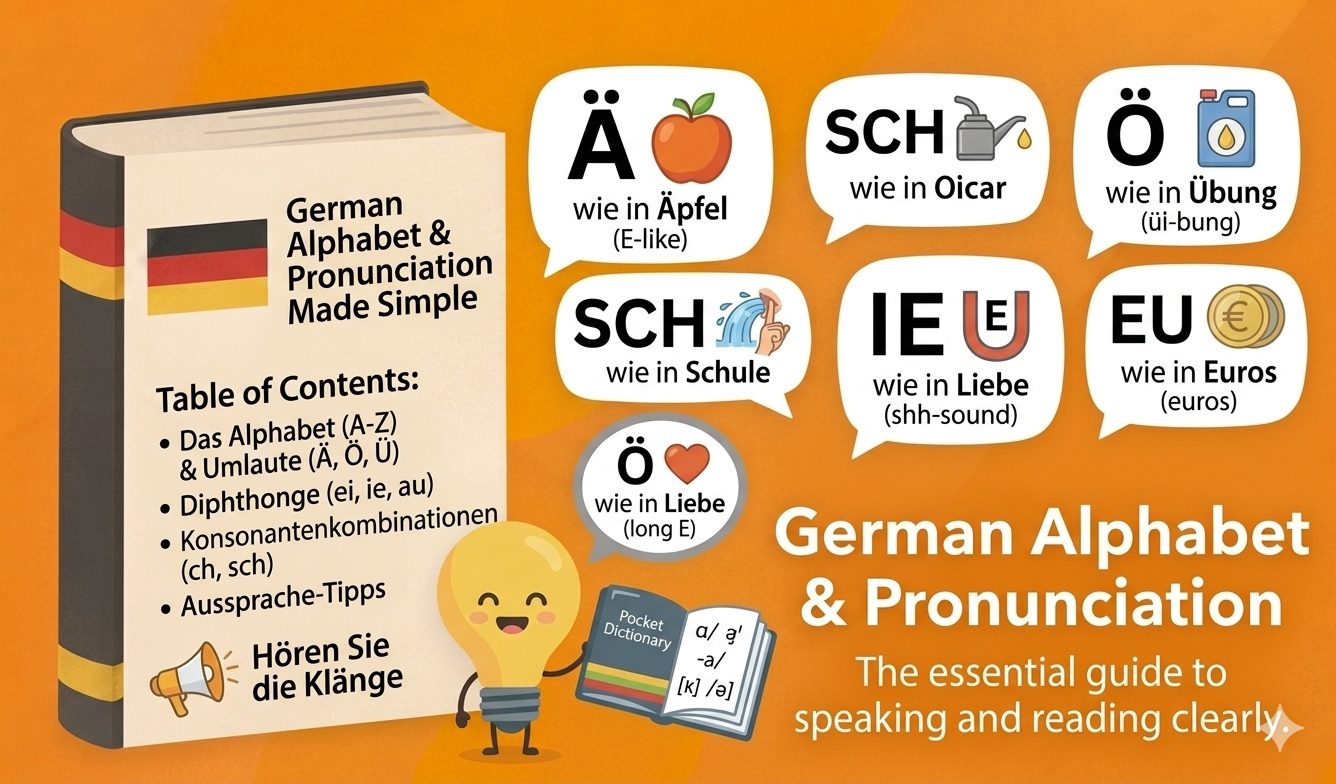
4. Umlauts (Ä, Ö, Ü)
These are unique sounds that don’t exist directly in English:
- Ä (ä) → like “e” in bed
- Example: Mädchen (girl)
- Ö (ö) → like “ir” in bird (rounded lips)
- Example: schön (beautiful)
- Ü (ü) → like “ee” in see but with rounded lips
- Example: über (over)
👉 Tip: Umlauts change word meanings, so pronunciation matters a lot.
5. The ß (Eszett)
- Pronounced like a sharp “s”
- Used after long vowels or diphthongs
Example:
- Straße (street) → “shtrah-se”
6. Consonant Pronunciation
Some German consonants sound different from English:
- V → sounds like “f”
- Vater → “fah-ter”
- W → sounds like “v”
- Wasser → “vah-ser”
- J → sounds like “y”
- Ja → “yah”
- Z → sounds like “ts”
- Zeit → “tsite”
- S → can sound like “z” at the beginning
- Sonne → “zon-neh”
- CH → two sounds:
- Soft (after e, i): ich → “ish”
- Hard (after a, o, u): Bach → “bakh”
7. German Diphthongs (Double Vowel Sounds)
- ei → “eye”
- mein → “mine”
- ie → “ee”
- Liebe → “lee-buh”
- au → “ow”
- Haus → “house”
- eu / äu → “oy”
- Freund → “froynd”
8. Stress & Intonation
- Most German words are stressed on the first syllable
- TAfel (table)
- MUTter (mother)
- Compound words stress the first part
- HAUSaufgabe (homework)
9. Common Pronunciation Mistakes (Avoid These!)
- ❌ Pronouncing W as “w” (it’s “v”)
- ❌ Ignoring umlauts (they change meanings)
- ❌ Softening consonants too much (German is more crisp)
- ❌ Guessing pronunciation like English (stick to rules)
10. Pro Tips to Master German Pronunciation
- Listen to native speakers (YouTube, podcasts)
- Practice reading aloud daily
- Record your voice and compare
- Focus on mouth shape (especially for umlauts)
- Learn words with audio, not just text
Final Thoughts
Learning the German alphabet and pronunciation is much easier than it looks. Once you understand the rules, you’ll be able to read, speak, and sound more confident quickly. German rewards consistency—so a little daily practice goes a long way.