German Question Words: Complete Guide with Examples (2026)
Understanding German question words (also called W-Fragen) is essential for speaking and understanding German fluently. Whether you’re a beginner or improving your conversational skills, mastering these words helps you ask clear, natural questions in everyday situations.
In this guide, you’ll learn all the important German question words, their meanings, usage, and real-life examples.
What Are German Question Words?
German question words are used to ask open-ended questions—questions that require more than a “yes” or “no” answer. Most of them begin with the letter “W”, which is why they are called W-Fragen.
List of German Question Words with Meanings
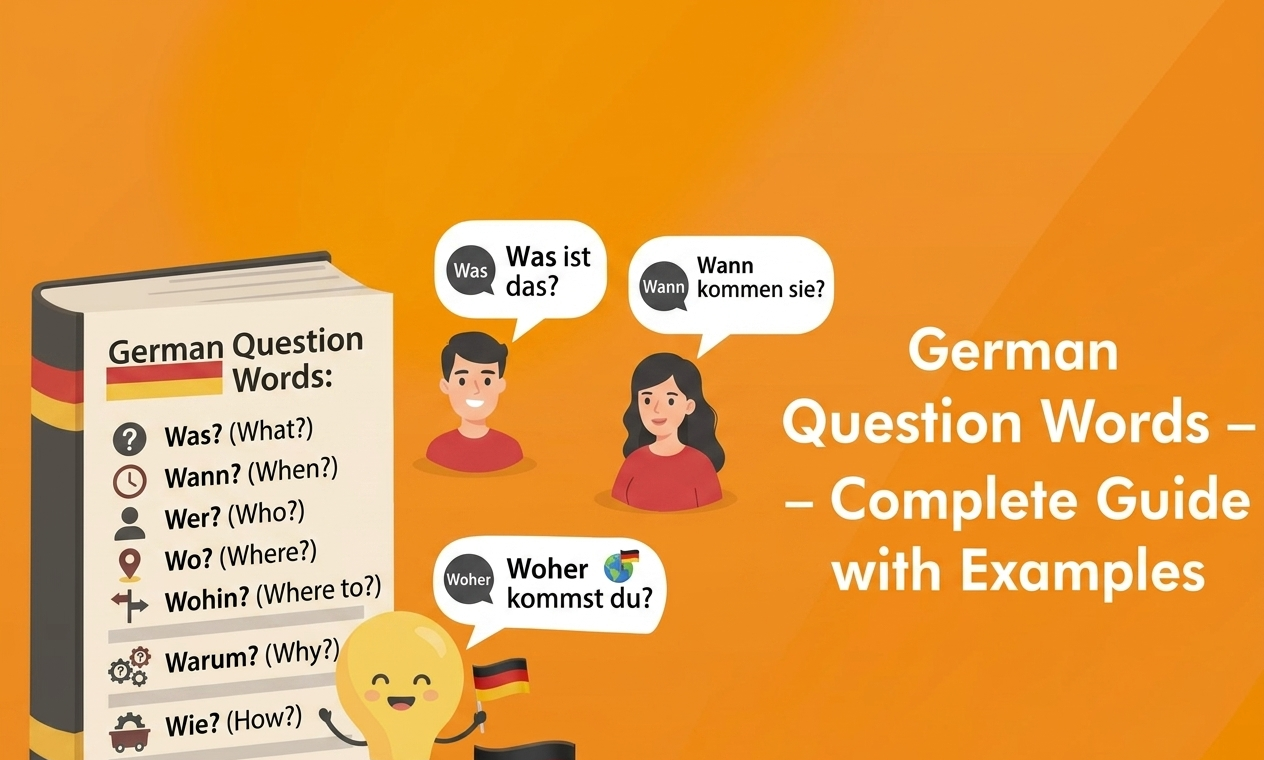
Here are the most commonly used German question words:
| German | English | Usage |
|---|---|---|
| Wer | Who | Asking about a person |
| Was | What | Asking about a thing or idea |
| Wann | When | Asking about time |
| Wo | Where | Asking about location |
| Warum | Why | Asking for a reason |
| Wie | How | Asking about manner |
| Welcher / Welche / Welches | Which | Choosing between options |
| Wessen | Whose | Asking about possession |
| Wem | To whom | Dative case (indirect object) |
| Wen | Whom | Accusative case (direct object) |
How to Use German Question Words
In German, the verb usually comes in the second position in a question.
Structure:
Question Word + Verb + Subject + Rest of Sentence
Example:
- Wo wohnst du? → Where do you live?
- Warum lernst du Deutsch? → Why are you learning German?
Examples of Each Question Word
1. Wer (Who)
- Wer ist das? → Who is that?
2. Was (What)
- Was machst du? → What are you doing?
3. Wann (When)
- Wann beginnt der Kurs? → When does the course start?
4. Wo (Where)
- Wo ist der Bahnhof? → Where is the train station?
5. Warum (Why)
- Warum bist du müde? → Why are you tired?
6. Wie (How)
- Wie geht es dir? → How are you?
7. Welcher / Welche / Welches (Which)
- Welches Buch liest du? → Which book are you reading?
8. Wessen (Whose)
- Wessen Tasche ist das? → Whose bag is that?
9. Wem (To whom)
- Wem gibst du das Geschenk? → To whom are you giving the gift?
10. Wen (Whom)
- Wen siehst du? → Whom do you see?
Important Tips to Remember
1. Verb Position is Key
Always place the verb immediately after the question word.
2. Case Matters (Advanced Learners)
Words like wem, wen, wessen change based on German grammar cases:
- Wen → Accusative (direct object)
- Wem → Dative (indirect object)
- Wessen → Genitive (possession)
3. “Wo” Variations
German has variations of “wo” for movement and direction:
- Wo → Where (location)
- Wohin → Where to (destination)
- Woher → Where from (origin)
Example:
- Wo bist du? → Where are you?
- Wohin gehst du? → Where are you going?
- Woher kommst du? → Where do you come from?
Common Mistakes to Avoid
- ❌ Saying: Warum du lernst Deutsch?
✔ Correct: Warum lernst du Deutsch? - ❌ Forgetting verb position
- ❌ Mixing up wen and wem
Practice Questions
Try forming your own questions:
- ______ lernst du Deutsch? (Why)
- ______ ist dein Lehrer? (Who)
- ______ gehst du heute? (Where to)
Answers:
- Warum
- Wer
- Wohin
Why Learning German Question Words Is Important
- Helps in daily conversations
- Essential for exams like Goethe & TestDaF
- Improves listening and speaking skills
- Makes communication natural and fluent
Final Thoughts
German question words are the foundation of asking meaningful questions. Once you understand how they work and practice regularly, you’ll find it much easier to communicate in German.
Start by memorizing the key words, practice sentence structures, and use them in real conversations.