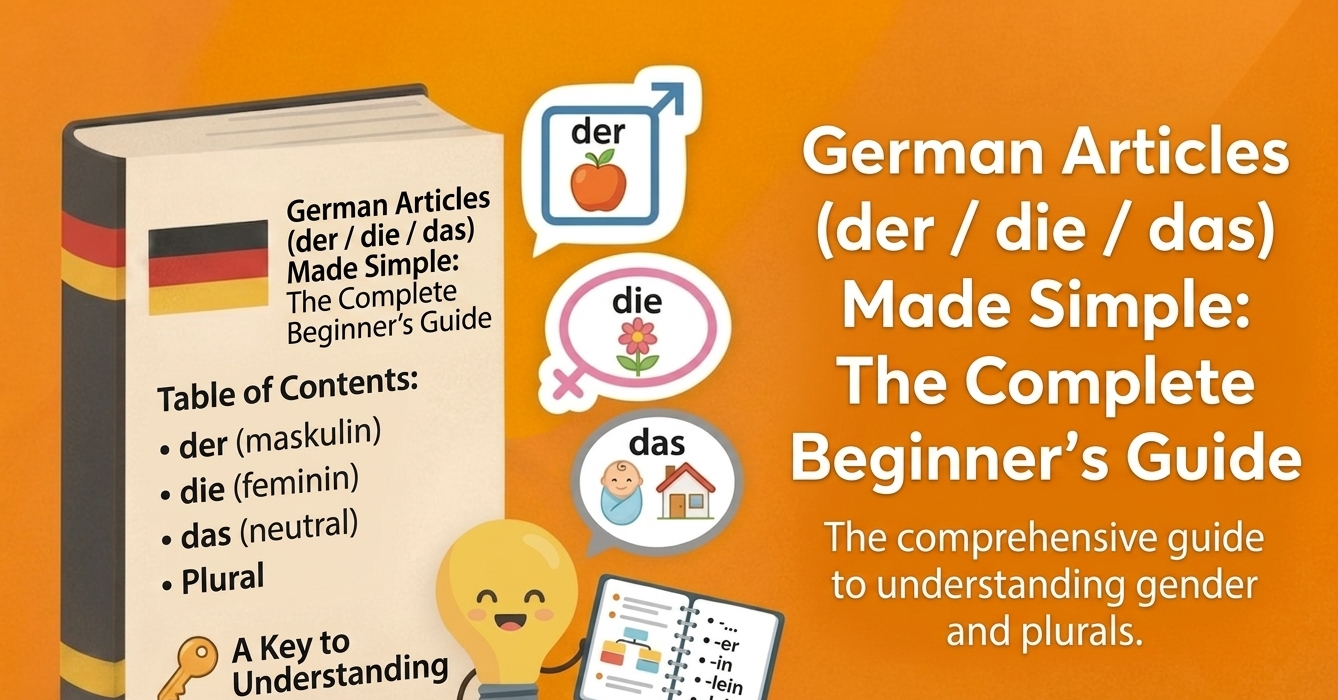
German Articles (der / die / das) Made Simple: The Complete Beginner’s Guide
If you have ever tried to say “the dog” in German and frozen because you could not remember whether it is der Hund, die Hund, or das Hund — you are not alone. German articles are one of the first real challenges every learner faces, and for good reason. Unlike English, which uses just one word — the — for everything, German has three definite articles that change depending on the gender of the noun, and they change again depending on how the noun is used in a sentence.
The good news? This is not random chaos. There are patterns, rules, and tricks that make learning German articles far more manageable than it first appears. This guide breaks everything down from scratch — what articles are, how gender works, how cases affect articles, and how to actually remember which article goes with which noun. Whether you are just starting out at A1 or consolidating your A2–B1 knowledge, this is the only guide you need.
Table of Contents
- What Are German Articles?
- The Three Genders: Masculine, Feminine, and Neuter
- Definite vs. Indefinite Articles
- How German Cases Change the Articles
- Rules and Patterns to Identify the Right Article
- 50 Common German Nouns with Their Articles
- Tricks to Memorize der / die / das
- Common Mistakes Learners Make with German Articles
- Practice Exercises
- Summary Reference Tables
1. What Are German Articles?
In English, articles are simple. The is the definite article — it refers to something specific. A or an is the indefinite article — it refers to something general or unspecified. German works the same way in concept, but the form of the article changes based on three things: the grammatical gender of the noun, the grammatical case, and whether the noun is singular or plural.
Here is the base form — what you will see when a noun is the subject of a sentence:
| Definite (“the”) | Indefinite (“a / an”) | |
|---|---|---|
| Masculine | der | ein |
| Feminine | die | eine |
| Neuter | das | ein |
| Plural | die | — |
This table is your foundation. Everything else in this guide builds on it. Once you understand why these forms exist and how they shift, German articles stop feeling like guesswork and start feeling like a system you can actually master.
→ For a complete side-by-side breakdown of when and how to use definite versus indefinite articles, visit our dedicated guide: German Definite vs Indefinite Articles.
2. The Three Genders — Masculine, Feminine, and Neuter
One of the biggest surprises for English speakers learning German is that every single noun has a grammatical gender — and that gender is not always logical or connected to biology. Das Mädchen, meaning “the girl,” is grammatically neuter. Der Stuhl, meaning “the chair,” is masculine. Die Sonne, the sun, is feminine.
Grammatical gender in German is a linguistic category. It was assigned to nouns centuries ago and has no consistent connection to real-world properties. That said, it is far from completely random, and that is exactly where patterns become your best tool.
Masculine nouns (der) include most male people and animals, all days of the week, months, and seasons, most alcoholic drinks, and nouns ending in -er, -ismus, -or, and -ling.
Feminine nouns (die) include most female people and animals, most flowers and trees, and nouns ending in -ung, -heit, -keit, -schaft, -tion, -tät, and -ik.
Neuter nouns (das) include all diminutives ending in -chen or -lein, most metals, most infinitives used as nouns, young animals, and nouns ending in -um, -ment, and -ium.
These patterns are not absolute rules — German always has exceptions — but they cover a large percentage of everyday vocabulary and give you a strong, reliable starting point when you encounter a new noun.
→ For the full list of gender patterns, noun endings, and the most important exceptions, visit: German Gender Rules Explained.
3. Definite vs. Indefinite Articles
Just as in English, German uses two types of articles. Definite articles (der, die, das) point to something specific or already known to the speaker and listener. Indefinite articles (ein, eine, ein) refer to something general, non-specific, or being introduced for the first time.
Compare these two sentences:
Ich sehe einen Hund. — I see a dog. (any dog, not a specific one) Ich sehe den Hund. — I see the dog. (a specific dog both people know about)
The distinction itself is intuitive because English works the same way. What trips learners up is that in German, the indefinite article also changes form depending on case — and the masculine and neuter forms are identical in the nominative (ein), which creates early confusion.
German also has a negative article — kein for masculine and neuter, keine for feminine and plural — which means “no” or “not a.” It follows exactly the same pattern as ein/eine and is best learned alongside the indefinite articles rather than separately.
→ For a full side-by-side comparison with examples across all cases, visit: German Definite vs Indefinite Articles.
4. How German Cases Change the Articles
This is the section where German articles become more complex — but also where understanding the full system pays off the most. German has four grammatical cases, and each one can change the form of the article attached to a noun.
The four cases are the nominative (the subject doing the action), the accusative (the direct object receiving the action), the dative (the indirect object, typically meaning “to” or “for” someone), and the genitive (showing possession, similar to “of” or the English apostrophe-s).
Definite article forms across all four cases:
| Case | Masculine | Feminine | Neuter | Plural |
|---|---|---|---|---|
| Nominative | der | die | das | die |
| Accusative | den | die | das | die |
| Dative | dem | der | dem | den |
| Genitive | des | der | des | der |
A few things to notice immediately. In the accusative, only the masculine article changes — der becomes den. Feminine, neuter, and plural stay identical to the nominative. This is one of the most useful shortcuts in German grammar. The dative feminine form der looks exactly like the masculine nominative der, which is a very common source of confusion for learners at every stage. And in the genitive, masculine and neuter nouns add an -s or -es ending to the noun itself in addition to the article changing.
The single most important habit you can build right now is this: whenever you use a noun in a sentence, ask yourself what role it is playing. Is it the subject? That is nominative. Is it the direct object? Accusative. Is it the recipient of something? Dative. Once you identify the case, the article form follows automatically.
→ For detailed explanations, examples, and exercises across all four cases, visit: German Cases Made Simple (with Articles).
5. How to Identify the Right Article for Any Noun
Without any rules at all, you would need to memorize the article for every German noun individually — an enormous, exhausting task. With pattern recognition, however, you can make an educated and often correct guess for most new nouns you encounter. Here are the most reliable signals to look for.
Noun endings are your strongest clue. When a noun ends in -ung, it is almost always feminine: die Zeitung, die Wohnung, die Meinung. When it ends in -chen or -lein, it is always neuter without exception: das Mädchen, das Häuschen, das Fräulein. When it ends in -keit or -heit, it is feminine: die Möglichkeit, die Freiheit. When it ends in -ment, it is neuter: das Instrument, das Dokument. These endings alone cover hundreds of common nouns.
The category a noun belongs to also predicts gender. All days of the week, months, and seasons are masculine without exception — der Montag, der März, der Winter. Most rivers within German-speaking countries are feminine — die Donau, die Elbe, die Mosel — with der Rhein being the most notable exception. Most metals are neuter — das Gold, das Silber, das Eisen. Most languages used as nouns are neuter — das Deutsch, das Englisch, das Französisch.
For compound nouns, always look at the last element. German creates new nouns by stacking existing ones together, and the gender of the compound is always determined by the final component. Das Hand does not exist, but das Tuch (cloth) does — so das Handtuch (towel) is neuter. Der Ball is masculine, so der Fußball is masculine. This single rule eliminates enormous uncertainty when you encounter long compound nouns.
→ For a complete visual guide to endings, categories, and identification shortcuts, visit: How to Identify German Articles Easily.
6. Common German Nouns with Their Articles (A1–A2)
One of the most effective habits you can build as a beginner is to always learn a noun together with its article — never the noun alone. Der Hund is one unit. Die Katze is one unit. Learning them separately and trying to attach the article later is significantly harder than learning the full phrase from the start.
Here is a core A1–A2 vocabulary list organized by gender to help you build that habit from the beginning.
Masculine (der): der Mann (man), der Hund (dog), der Tisch (table), der Stuhl (chair), der Tag (day), der Zug (train), der Arzt (doctor, male), der Freund (friend, male), der Beruf (profession), der Schlüssel (key)
Feminine (die): die Frau (woman), die Katze (cat), die Schule (school), die Straße (street), die Wohnung (apartment), die Zeit (time), die Arbeit (work), die Ärztin (doctor, female), die Freundin (friend, female), die Zeitung (newspaper)
Neuter (das): das Kind (child), das Buch (book), das Auto (car), das Haus (house), das Bett (bed), das Wasser (water), das Essen (meal/food), das Mädchen (girl), das Fenster (window), das Wort (word)
→ For a full list of 100+ essential nouns organized by topic and gender, visit: Common German Nouns with Articles (A1–A2 List).
7. Tricks to Memorize der / die / das Faster
Knowing the rules intellectually and actually recalling the right article in the middle of a conversation are two very different skills. These techniques help bridge that gap.
The color-coding method is one of the most widely recommended approaches by German teachers. Assign a consistent color to each gender — blue for masculine, red for feminine, green for neuter is the most common system. Whenever you write vocabulary, write every noun in its gender color. Over time, when you visualize the word, the color automatically cues the gender. This works because it adds a visual memory layer on top of the linguistic one.
Learning with audio from day one makes a significant difference. When you hear and repeat der Hund as a single sound unit rather than reading Hund and mentally attaching der as an afterthought, your brain encodes the article as part of the word’s rhythm and sound pattern. This makes retrieval far more automatic in speech.
Spaced repetition flashcards — particularly using apps like Anki — are arguably the most efficient method for vocabulary retention at scale. The critical rule is always including the article on the card. If the front of the card says Hund, the back should say der Hund, not just “dog.” Reviewing at algorithmically optimized intervals means you spend less time on words you already know and more time on the ones you keep forgetting.
The three-repetition spoken rule is simple and effective for new words. Every time you encounter a new noun, say the full article-noun pair three times out loud — der Tisch, der Tisch, der Tisch. Vocalization combined with repetition creates significantly stronger memory traces than reading silently.
Story and image associations work especially well for nouns that resist the pattern-based approach. Create a vivid, even absurd mental image that links the noun to its gender. The more specific and unusual the image, the longer it stays in memory.
→ For all eight proven memorization methods with examples and implementation tips, visit: Tricks to Memorize der / die / das Faster.
8. Common Mistakes Learners Make with German Articles
Even learners at intermediate level make consistent, predictable errors with German articles. Knowing them in advance is one of the most efficient things you can do.
Learning nouns without their articles is by far the most damaging habit a beginner can form. If you learn Hund in isolation and try to recall the article separately every time you use it, you will always be guessing. The article must be learned as part of the noun from the very first encounter. There is no shortcut around this.
Confusing dative der with nominative der causes constant errors at A2 and B1 level. The dative feminine article is der, which looks identical to the masculine nominative der. When a learner sees Ich gebe der Frau das Buch and reads der Frau as masculine, they have made this exact mistake. Frau is feminine — der here is the dative feminine form, not masculine nominative.
Over-correcting in the accusative is equally common. Learners learn that articles change in the accusative and begin changing all of them. In reality, only the masculine article changes in the accusative — der becomes den. Feminine (die), neuter (das), and plural (die) stay exactly the same as in the nominative.
Assuming grammatical and biological gender always match leads to errors with nouns like das Mädchen (neuter) or das Mitglied (neuter, meaning “member”). German grammatical gender is a property of the word, not a reflection of the thing it describes.
Ignoring gender when learning compound nouns is a mistake that quietly accumulates. Every compound noun’s gender is determined by its final element. Skipping this rule means every long compound noun becomes a new gender mystery instead of something you can confidently predict.
→ For the full breakdown of each error type, why it happens, and exactly how to fix it, visit: Mistakes to Avoid with German Articles.
9. Practice — Test What You Have Learned
The fastest way to move knowledge from understanding to automatic use is through active practice. Try these exercises before looking at the answers.
Fill in the correct definite article (nominative): ___ Hund schläft. / ___ Frau liest. / ___ Kind spielt.
Fill in the correct definite article (accusative): Ich sehe ___ Mann. / Sie kauft ___ Buch. / Er trinkt ___ Kaffee.
Identify the gender from the noun ending: die Freiheit → ending -heit → gender: ? / der Tourismus → ending -ismus → gender: ? / das Mädchen → ending -chen → gender: ?
Answers: Nominative: der, die, das | Accusative: den, das, den | Genders: feminine, masculine, neuter
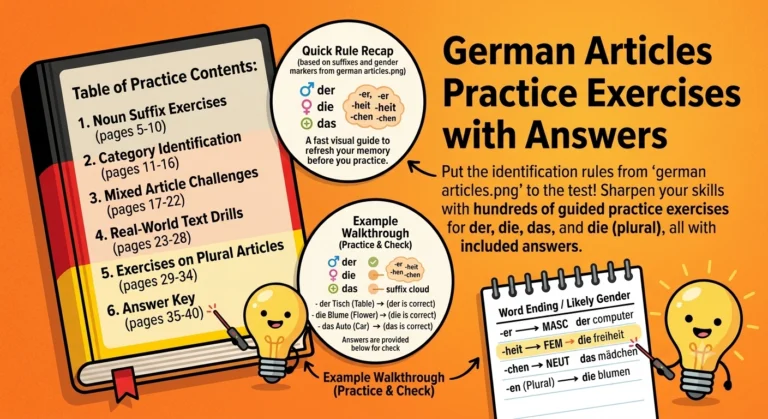
→ For complete practice sets at A1, A2, and B1 levels with full explanations for every answer, visit: German Articles Practice Exercises (with Answers).
10. Complete Reference Tables
Keep this section bookmarked. It contains every article form you need across all genders and cases.
Definite Articles:
| Case | Masculine | Feminine | Neuter | Plural |
|---|---|---|---|---|
| Nominative | der | die | das | die |
| Accusative | den | die | das | die |
| Dative | dem | der | dem | den |
| Genitive | des | der | des | der |
Indefinite Articles:
| Case | Masculine | Feminine | Neuter |
|---|---|---|---|
| Nominative | ein | eine | ein |
| Accusative | einen | eine | ein |
| Dative | einem | einer | einem |
| Genitive | eines | einer | eines |
Conclusion
German articles might look intimidating when you first encounter three words where English has just one — but once you understand how gender, noun endings, and cases work together, the system reveals its underlying logic. Start by learning every new noun with its article as a single unit. Use the ending patterns to make confident guesses with unfamiliar words. Return to the declension tables regularly until the forms become second nature.
This guide is your home base. Each topic covered here has its own dedicated deep-dive resource. Use the links throughout this article to go further on whichever area you want to master next.