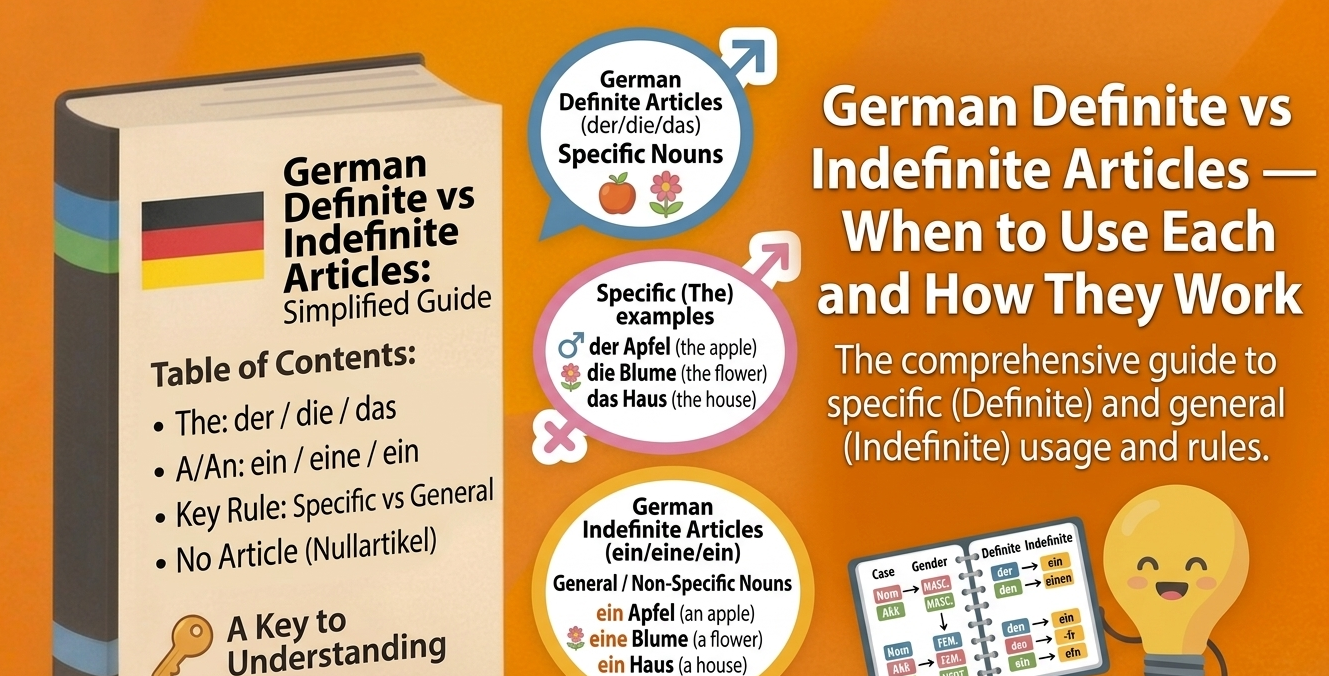
German Definite vs Indefinite Articles — When to Use Each and How They Work
If you have spent even a few hours studying German, you have already met der, die, das, ein, and eine. You probably know that the first group means “the” and the second means “a” or “an.” But knowing that they exist and actually using them correctly in sentences are two very different things.
This guide goes beyond the basic introduction. You will learn exactly when to use a definite article and when to reach for the indefinite one, how both sets of articles change across all four German cases, and where the negative article kein fits into the picture. By the end, the choice between der Hund and ein Hund will feel completely natural.
→ This article is part of the complete series on German articles. If you are new to the topic, start with the main guide: German Articles (der / die / das) Made Simple.
1. The Core Difference
The fundamental difference between definite and indefinite articles is one of specificity and shared knowledge. A definite article says: both the speaker and the listener know exactly which thing is being referred to. An indefinite article says: this thing is not yet specific, or it is being introduced for the first time.
English works exactly the same way:
I saw a film last night. — First mention, non-specific. The film was excellent. — Now both speaker and listener know which film.
German follows this exact same logic. The only added complexity is that German articles change form depending on the gender of the noun and the grammatical role it plays in the sentence. The conceptual rule — definite for known, indefinite for unknown — never changes.
2. The German Definite Articles
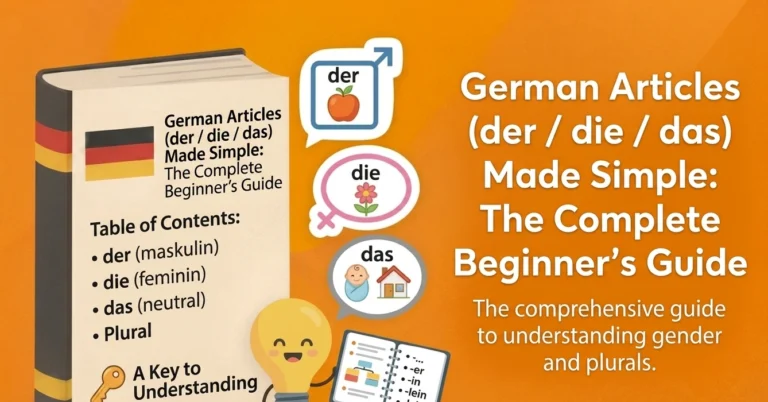
German has four definite articles in the nominative case — one for each gender and one for plural nouns. They all translate to the English word “the.”
Der is used with masculine nouns: der Mann (the man), der Hund (the dog), der Tisch (the table).
Die is used with feminine nouns: die Frau (the woman), die Katze (the cat), die Stadt (the city).
Das is used with neuter nouns: das Kind (the child), das Buch (the book), das Auto (the car).
Die is used with all plural nouns regardless of gender: die Männer (the men), die Frauen (the women), die Kinder (the children).
The fact that die covers both feminine singular and all plurals is one of the first things that confuses beginners. Context almost always makes the meaning clear, but it is worth being aware of from the start.
3. The German Indefinite Articles
German indefinite articles translate to the English “a” or “an.” They exist only in singular form — there is no indefinite article for plural nouns in German, just as in English you would not say “a dogs.”
Ein is used with masculine nouns: ein Mann (a man), ein Hund (a dog), ein Tisch (a table).
Eine is used with feminine nouns: eine Frau (a woman), eine Katze (a cat), eine Stadt (a city).
Ein is also used with neuter nouns: ein Kind (a child), ein Buch (a book), ein Auto (a car).
The fact that masculine and neuter share the same form ein in the nominative is an important detail. This is where beginners sometimes lose track of gender — ein Mann and ein Kind look identical in the nominative, even though one is masculine and one is neuter. The difference becomes visible in the accusative and other cases.
4. The Negative Article — kein / keine
Alongside the definite and indefinite articles, German has a third category that beginners often overlook: the negative article. Kein (masculine and neuter) and keine (feminine and plural) mean “no,” “not a,” or “not any.”
Compare these three sentences:
Das ist ein Hund. — That is a dog. Das ist der Hund. — That is the dog. Das ist kein Hund. — That is not a dog.
Kein/keine follows exactly the same declension pattern as ein/eine, which makes it straightforward to learn once you have the indefinite articles down. The only difference is that kein also has a plural form — keine — because it negates nouns in a way that ein cannot.
Ich habe keine Kinder. — I have no children. Ich habe keine Zeit. — I have no time. Das ist kein Problem. — That is not a problem.
Learning kein/keine alongside the indefinite articles rather than as a separate topic later saves significant confusion at the intermediate stage.
5. Definite Article Declension Across All Four Cases
German articles do not stay in one fixed form. They change depending on the grammatical case of the noun — that is, the role the noun plays in the sentence. Here is the full declension of the definite article:
| Case | Masculine | Feminine | Neuter | Plural |
|---|---|---|---|---|
| Nominative | der | die | das | die |
| Accusative | den | die | das | die |
| Dative | dem | der | dem | den |
| Genitive | des | der | des | der |
Three patterns in this table are worth memorizing explicitly because they cause the most confusion.
First, in the accusative, only the masculine changes. Der becomes den. Every other gender stays identical to the nominative. This single fact eliminates a huge amount of uncertainty in everyday sentences.
Second, the dative feminine is der — identical to the masculine nominative. When you see der in a sentence, always check whether the noun following it is feminine and in a dative context before assuming it is masculine nominative.
Third, genitive masculine and neuter use des, and the noun itself typically adds an -s or -es ending: des Mannes, des Kindes. This double signal — article change plus noun ending — is how German marks possession without using a separate word like “of.”
6. Indefinite Article Declension Across All Four Cases
The indefinite article follows a very similar pattern with one key difference — masculine and neuter look identical in the nominative, but they diverge in the accusative.
| Case | Masculine | Feminine | Neuter |
|---|---|---|---|
| Nominative | ein | eine | ein |
| Accusative | einen | eine | ein |
| Dative | einem | einer | einem |
| Genitive | eines | einer | eines |
The accusative masculine einen is one of the most important forms for beginners to nail early because it appears constantly in everyday speech. Ich sehe einen Mann (I see a man) is the kind of sentence you will use from your very first week of speaking German.
Notice that in the accusative, neuter remains ein — identical to the nominative. This means that for neuter nouns, the nominative and accusative indefinite article are always the same, which simplifies things considerably when you are building sentences with neuter objects.
The kein/keine negative article follows this exact same table — simply replace ein with kein and eine with keine across all positions.
7. Side-by-Side Comparison
Here is a consolidated view of how definite and indefinite articles align across genders in the two most commonly used cases — nominative and accusative:
Nominative (subject of the sentence):
| Gender | Definite | Indefinite |
|---|---|---|
| Masculine | der | ein |
| Feminine | die | eine |
| Neuter | das | ein |
| Plural | die | — |
Accusative (direct object):
| Gender | Definite | Indefinite |
|---|---|---|
| Masculine | den | einen |
| Feminine | die | eine |
| Neuter | das | ein |
| Plural | die | — |
The parallel structure between definite and indefinite is clearer when you see them side by side. Both change masculine to -en in the accusative. Both leave feminine and neuter unchanged from nominative to accusative. The patterns mirror each other, which means learning one reinforces the other.
8. When to Use Definite Articles — Rules with Examples
Understanding the grammar tables is one thing. Knowing when to actually reach for der, die, or das in real sentences is the practical skill. Here are the main situations that call for a definite article.
When both the speaker and listener know which specific thing is meant. This is the core rule. Once a noun has been introduced in a conversation, subsequent references to it use the definite article.
Ich habe ein Buch gekauft. Das Buch ist sehr gut. — I bought a book. The book is very good.
When referring to something unique or one of a kind. Things that only exist once in a shared context take the definite article automatically.
Die Sonne scheint heute. — The sun is shining today. Der Präsident hat gesprochen. — The president has spoken.
When referring to a category or concept in general. In German, definite articles are used with nouns that represent an entire category in a general statement — something English sometimes omits.
Der Hund ist ein treues Tier. — The dog is a loyal animal. (meaning dogs in general) Das Gold ist schwer. — Gold is heavy. (the element as a category)
With geographical names that have grammatical gender. Countries, rivers, and regions that carry a gender in German use the definite article.
Die Schweiz ist wunderschön. — Switzerland is beautiful. Der Rhein fließt durch Deutschland. — The Rhine flows through Germany.
With days, months, and seasons when used in a general sense.
Im Winter ist es kalt. — In winter it is cold. (im is a contraction of in dem) Der Montag ist mein schwieriger Tag. — Monday is my difficult day.
With abstract nouns in certain fixed expressions and general statements.
Das Leben ist schön. — Life is beautiful. Die Liebe ist kompliziert. — Love is complicated.
9. When to Use Indefinite Articles — Rules with Examples
When introducing something for the first time. If the listener does not yet know which specific thing you are referring to, use the indefinite article.
Ich sehe einen Mann an der Tür. — I see a man at the door. (first mention, could be any man)
When describing what something is — a profession, nationality, religion, or category. After verbs like sein (to be) and werden (to become), German uses an indefinite article when identifying what someone or something is.
Er ist ein Arzt. — He is a doctor. Sie wird eine Lehrerin. — She is becoming a teacher.
Note: In spoken German, the article is sometimes dropped in these constructions — Er ist Arzt is also correct and very common. Adding the article makes the statement slightly more emphatic.
When something is one of many rather than a specific known thing.
Kannst du mir ein Taxi rufen? — Can you call me a taxi? (any taxi, not a specific one) Ich brauche einen Stift. — I need a pen. (any pen will do)
When describing someone or something for the first time in a story or narrative.
Es war einmal eine Prinzessin. — Once upon a time there was a princess. Ein Mann betrat das Restaurant. — A man entered the restaurant.
10. The Zero Article — When German Uses No Article at All
This is a feature that many textbooks introduce too late, leaving learners confused when they encounter sentences with no article at all. German regularly drops the article in predictable situations.
Professions, nationalities, and religions after sein and werden without an adjective.
Ich bin Ingenieur. — I am an engineer. Sie ist Deutsche. — She is German. Er ist Muslim. — He is Muslim.
As soon as an adjective enters the picture, the indefinite article returns: Ich bin ein guter Ingenieur.
Uncountable nouns used in a general, non-specific sense.
Ich trinke gern Kaffee. — I like drinking coffee. (coffee in general, not a specific cup) Sie kauft Brot. — She is buying bread.
Set phrases and fixed expressions.
Ich habe Hunger. — I am hungry. (literally: I have hunger) Er hat Fieber. — He has a fever. Wir haben Angst. — We are afraid.
After certain prepositions in fixed combinations.
zu Hause (at home), nach Hause (towards home), in der Schule (at school — but this one uses the definite article)
With most country and city names.
Ich komme aus Deutschland. — I come from Germany. Er wohnt in Berlin. — He lives in Berlin.
The zero article catches learners off guard because there is no visible signal — the article is simply absent. Recognizing these patterns early prevents the habit of forcing an article where German naturally uses none.
11. Common Mistakes and How to Avoid Them
Using the indefinite article where a definite article is needed on second mention. This is the most frequent error at beginner level. Once a noun has been introduced in a conversation or text, the definite article should take over. Continuing to use ein/eine after the first mention sounds unnatural and suggests the speaker and listener do not share knowledge of the specific thing being discussed.
Confusing masculine and neuter in the nominative. Because ein Mann and ein Kind both use ein in the nominative, learners sometimes forget which gender they are dealing with. The gender reasserts itself in the accusative — einen Mann versus ein Kind — which is why learning the accusative forms early is so valuable.
Forgetting kein/keine entirely and using nicht ein instead. The grammatically correct way to negate a noun in most contexts is kein/keine, not nicht ein. Das ist nicht ein Hund is technically understandable but sounds awkward and unnatural to native speakers. Das ist kein Hund is the correct form.
Using the definite article with professions after sein. English speakers often translate “He is the doctor” literally and produce Er ist der Arzt when they mean to say Er ist Arzt or Er ist ein Arzt depending on context. Er ist der Arzt implies a specific, known doctor — say, the one who was just mentioned — rather than identifying his profession.
Dropping the article before abstract nouns that require it in German. English frequently uses no article with abstract nouns: “Love is complicated,” “Life is beautiful.” German often uses the definite article in these statements: Die Liebe ist kompliziert, Das Leben ist schön. Translating directly from English leads to missing articles in German.
12. Practice Exercises with Answers
Work through these before checking the answers. They cover the most important distinctions from this guide.
Exercise 1 — Choose the correct article: definite or indefinite.
Situation: You are mentioning a cat for the first time. Ich sehe ___ Katze. (eine / die)
Situation: You are referring to the same cat again. ___ Katze ist schwarz. (eine / die)
Situation: You are identifying your profession. Ich bin ___ Lehrerin. (eine / die — or zero article?)
Exercise 2 — Fill in the correct form of the indefinite article.
Ich habe ___ Bruder. (masculine accusative) Er kauft ___ Auto. (neuter accusative) Sie gibt ___ Frau das Buch. (feminine dative)
Exercise 3 — Replace the underlined noun phrase with the negative article.
Ich habe ein Auto. → negated: ___ Das ist eine Lösung. → negated: ___ Wir haben Kinder. → negated: ___
Answers:
Exercise 1: eine / Die / zero article (or eine, with emphasis) Exercise 2: einen / ein / einer Exercise 3: Ich habe kein Auto. / Das ist keine Lösung. / Wir haben keine Kinder.