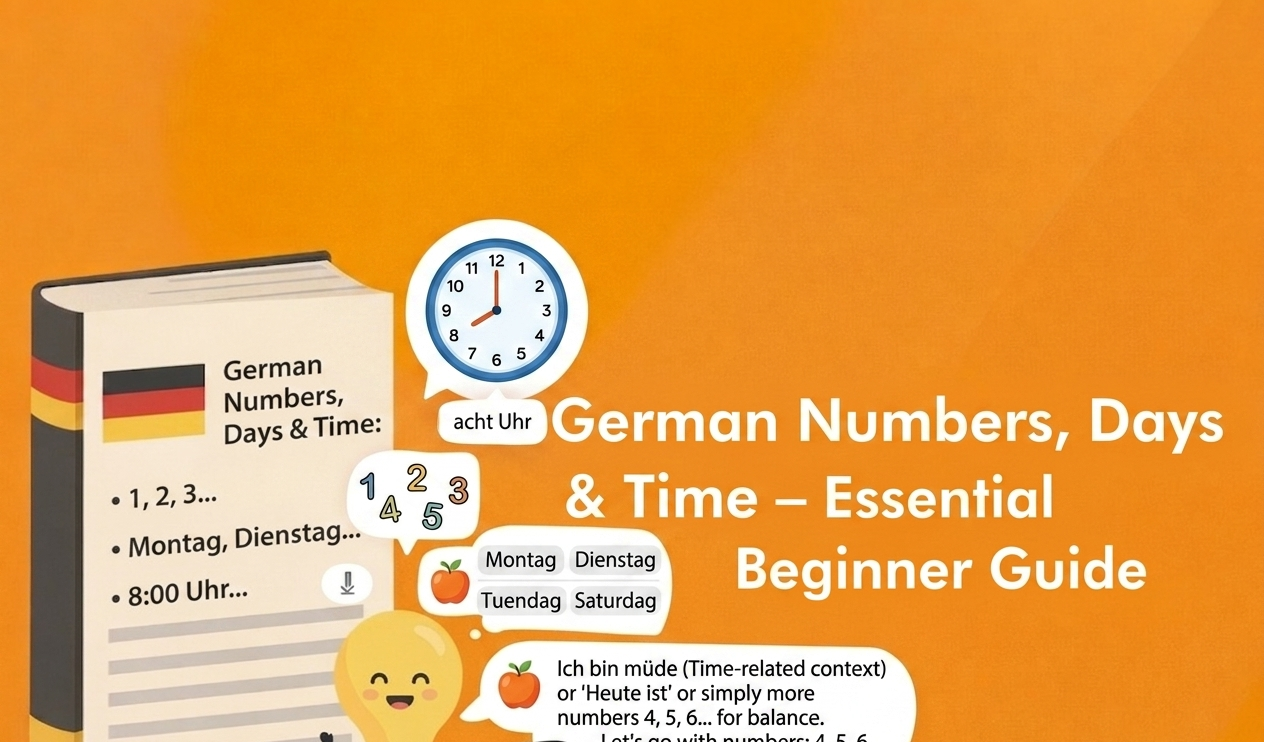
German Numbers, Days & Time: Complete Beginner Guide (With Examples)
Learning German basics starts with understanding numbers, days, and time expressions. These are essential for daily conversations, travel, exams like IELTS/German proficiency tests, and real-life interactions.
This guide is structured for fast learning + SEO ranking, with examples, pronunciation tips, and practical usage.
1. German Numbers (Zahlen)
German numbers follow logical patterns, making them easy to learn once you understand the structure.
🔢 Numbers 0–20
| Number | German | Pronunciation |
|---|---|---|
| 0 | null | nool |
| 1 | eins | ayns |
| 2 | zwei | tsvai |
| 3 | drei | dry |
| 4 | vier | feer |
| 5 | fünf | fuenf |
| 6 | sechs | zeks |
| 7 | sieben | zee-ben |
| 8 | acht | akht |
| 9 | neun | noyn |
| 10 | zehn | tseyn |
| 11 | elf | elf |
| 12 | zwölf | tsvolf |
| 13 | dreizehn | dry-tseyn |
| 20 | zwanzig | tsvan-tsig |
🔢 Numbers 21–100 (Important Rule)
German reverses numbers like this:
👉 21 = einundzwanzig (one-and-twenty)
👉 35 = fünfunddreißig (five-and-thirty)
Formula:
unit + “und” + tens
🔢 Hundreds & Thousands
- 100 = hundert
- 200 = zweihundert
- 1000 = tausend
- 10,000 = zehntausend
👉 Example:
- 1,245 = eintausendzweihundertfünfundvierzig
2. Days of the Week (Wochentage)
Knowing days is essential for scheduling, appointments, and conversations.
| English | German | Example |
|---|---|---|
| Monday | Montag | Am Montag |
| Tuesday | Dienstag | Am Dienstag |
| Wednesday | Mittwoch | Am Mittwoch |
| Thursday | Donnerstag | Am Donnerstag |
| Friday | Freitag | Am Freitag |
| Saturday | Samstag | Am Samstag |
| Sunday | Sonntag | Am Sonntag |
🧠 Pro Tip:
- All days are masculine (der) in German.
- Use “am” (on the) before days.
👉 Example:
- Ich arbeite am Montag (I work on Monday)
3. Months in German (Monate)
| English | German |
|---|---|
| January | Januar |
| February | Februar |
| March | März |
| April | April |
| May | Mai |
| June | Juni |
| July | Juli |
| August | August |
| September | September |
| October | Oktober |
| November | November |
| December | Dezember |
👉 Easy tip: Most months are similar to English.
4. Telling Time in German (Uhrzeit)
⏰ Basic Time Structure
👉 “Es ist … Uhr” = “It is … o’clock”
- 1:00 → Es ist ein Uhr
- 3:00 → Es ist drei Uhr
⏰ Minutes (Important Patterns)
| Time | German |
|---|---|
| 2:15 | Viertel nach zwei |
| 2:30 | Halb drei (half to three!) |
| 2:45 | Viertel vor drei |
⚠️ Important Concept
German uses relative time, not exact like English:
- Halb drei = 2:30 (halfway to 3)
- Viertel vor drei = 2:45
⏰ Formal Time (24-hour format)
Used in:
- Train schedules
- Offices
- Exams
👉 Example:
- 14:30 → vierzehn Uhr dreißig
5. Asking Time in German
- Wie spät ist es? → What time is it?
- Wie viel Uhr ist es? → What time is it?
👉 Answer:
- Es ist zehn Uhr (It is 10 o’clock)
6. Useful Time Vocabulary
| German | English |
|---|---|
| heute | today |
| morgen | tomorrow |
| gestern | yesterday |
| jetzt | now |
| später | later |
| früh | early |
| spät | late |
7. Real-Life Example Sentences
- Ich habe am Freitag ein Meeting.
- Der Zug kommt um 15 Uhr.
- Wir treffen uns um halb acht.
- Heute ist Montag.
8. Common Mistakes to Avoid
❌ Saying “half three” as 3:30
✔️ In German, it means 2:30
❌ Forgetting “am” before days
✔️ Always say: am Montag
❌ Mixing word order in numbers
✔️ Always: unit + und + tens
9. Quick Practice
👉 Translate:
- 27 → ?
- Monday → ?
- 2:30 → ?
Answers:
- siebenundzwanzig
- Montag
- halb drei
10. Conclusion
Mastering German numbers, days, and time builds a strong foundation for fluency. These basics are used in:
- Daily conversations
- Travel situations
- Job interviews
- Language exams
If you practice consistently, you’ll quickly start understanding and speaking German naturally.