German Sentence Structure Explained (Beginner to Advanced Guide)
German sentence structure may look confusing at first, but it actually follows very clear rules. Once you understand the verb position, word order, and case usage, forming German sentences becomes much easier. This guide explains German sentence structure in a simple way with examples, so beginners can learn step-by-step.
1. Basic German Sentence Structure (Subject – Verb – Object)
The most common German sentence structure is:
Subject + Verb + Object
This is similar to English.
Example:
-
Ich lerne Deutsch.
(I learn German.) -
Er kauft ein Buch.
(He buys a book.) -
Wir trinken Kaffee.
(We drink coffee.)
In simple sentences, the verb is always in the second position.
Rule:
✔ Verb = 2nd position
✔ Subject usually comes first
✔ Object comes after the verb
2. Verb in Second Position Rule (Very Important)
In German, the main verb must always be in the second position, not necessarily the second word.
Example:
-
Heute lerne ich Deutsch.
(Today I learn German.)
Here:
-
Heute = 1st position
-
lerne = verb (2nd position)
-
ich = subject (comes after verb)
Another example:
-
Morgen geht er zur Schule.
(Tomorrow he goes to school.)
Rule:
Position 1 → anything
Position 2 → verb
Position 3 → subject or object
This rule is one of the most important rules in German grammar.
3. Yes/No Questions Structure
In yes/no questions, the verb comes first.
Structure:
Verb + Subject + Object
Examples:
-
Lernst du Deutsch?
(Are you learning German?) -
Hast du Zeit?
(Do you have time?) -
Kommst du heute?
(Are you coming today?)
Rule:
✔ Verb first
✔ Subject second
✔ Rest later
4. W-Questions in German
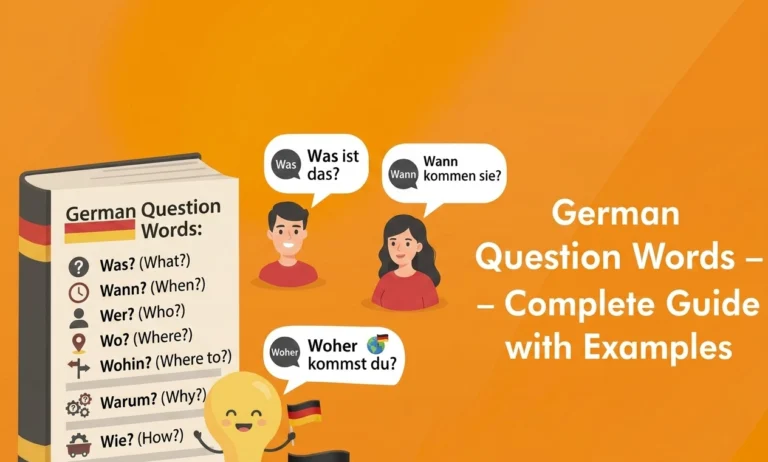
W-questions start with a question word.
Common question words:
-
Was = what
-
Wer = who
-
Wann = when
-
Warum = why
-
Wo = where
-
Wie = how
Structure:
Question word + Verb + Subject + Object
Examples:
-
Warum lernst du Deutsch?
-
Wann kommt er?
-
Wo wohnst du?
Rule:
✔ Question word first
✔ Verb second
✔ Subject after verb
5. German Sentence Structure with Modal Verbs
When using modal verbs (können, müssen, wollen, sollen, dürfen, mögen):
Structure:
Subject + Modal verb + Object + Main verb (at end)
Examples:
-
Ich kann Deutsch sprechen.
-
Wir wollen heute lernen.
-
Er muss arbeiten.
Rule:
✔ Modal verb = 2nd position
✔ Main verb = at the end
6. German Sentence Structure with Two Verbs (Perfect Tense)
In perfect tense, the helping verb is in second position and the main verb goes to the end.
Structure:
Subject + haben/sein + Object + past participle
Examples:
-
Ich habe Deutsch gelernt.
-
Er ist nach Hause gegangen.
-
Wir haben das Buch gelesen.
Rule:
✔ Helping verb = position 2
✔ Main verb = end
7. German Sentence Structure with Time, Manner, Place (TMP Rule)
German often follows:
Time – Manner – Place
Examples:
-
Ich gehe heute mit dem Bus zur Schule.
(Time → Manner → Place) -
Wir lernen morgen zu Hause Deutsch.
This rule helps make sentences sound natural.
8. Subordinate Clauses (Verb Goes to the End)
When using words like:
-
weil = because
-
dass = that
-
wenn = if / when
-
obwohl = although
The verb goes to the end.
Examples:
-
Ich lerne Deutsch, weil ich in Deutschland arbeiten will.
-
Er sagt, dass er müde ist.
-
Wenn ich Zeit habe, komme ich.
Rule:
✔ Subordinate clause → verb at end
9. German Sentence Structure Examples
| English | German |
|---|---|
| I am learning German today | Ich lerne heute Deutsch |
| Today I am learning German | Heute lerne ich Deutsch |
| Are you learning German? | Lernst du Deutsch? |
| I want to learn German | Ich will Deutsch lernen |
| I learned German | Ich habe Deutsch gelernt |
| I learn German because I like it | Ich lerne Deutsch, weil ich es mag |
10. Tips to Master German Sentence Structure
-
Always remember → Verb is in position 2
-
In questions → Verb comes first
-
With modal verbs → Main verb goes to end
-
With weil/dass/wenn → Verb goes to end
-
Use Time – Manner – Place order
Practice simple sentences first, then move to complex ones.
Conclusion
German sentence structure may seem difficult at the beginning, but it becomes easy once you learn the verb-second rule, question structure, and subordinate clause rules. By practicing regularly, you can quickly start forming correct German sentences and improve your speaking and writing skills.