German Pronunciation Guide for Beginners
Learning German pronunciation can feel difficult at first, but the good news is that German is actually one of the most phonetic languages in the world. This means words are usually pronounced exactly the way they are written. Once you learn the basic sounds, reading and speaking German becomes much easier.
This German pronunciation guide for beginners will help you understand the alphabet, vowel sounds, umlauts, special letter combinations, and common pronunciation rules.
Why German Pronunciation Is Easier Than English
Many beginners think German is hard, but pronunciation is often easier than English because:
-
Most letters have only one sound
-
Words are pronounced clearly
-
Silent letters are rare
-
Spelling usually matches pronunciation
For example:
-
Haus → pronounced exactly like “house”
-
Name → pronounced “Nah-meh”
-
Auto → pronounced “Ow-to”
Because of these rules, beginners can learn pronunciation quickly.
German Alphabet Pronunciation (A–Z)
German uses the same alphabet as English plus four extra letters.
| Letter | Pronunciation | Example | Sound |
|---|---|---|---|
| A | ah | Apfel | ah |
| B | beh | Ball | b |
| C | tseh | Café | ts / k |
| D | deh | Dank | d |
| E | eh | Essen | eh |
| F | eff | Fisch | f |
| G | geh | Gut | g |
| H | hah | Haus | h |
| I | ee | Ich | ee |
| J | yot | Ja | y |
| K | kah | Kind | k |
| L | ell | Land | l |
| M | emm | Mann | m |
| N | enn | Nein | n |
| O | oh | Brot | o |
| P | peh | Papa | p |
| Q | koo | Quelle | kv |
| R | err | Rot | r |
| S | ess | Sonne | s / z |
| T | teh | Tag | t |
| U | oo | Hund | u |
| V | fau | Vater | f |
| W | veh | Wasser | v |
| X | iks | Taxi | ks |
| Y | ipsilon | Yoga | y |
| Z | tset | Zeit | ts |
Extra letters:
-
Ä
-
Ö
-
Ü
-
ß
German Vowel Sounds
German vowels are very important because small changes can change the meaning.
A
Short → Mann
Long → Vater
E
Short → Bett
Long → Leben
I
Short → mit
Long → Liebe
O
Short → Sonne
Long → Brot
U
Short → Hund
Long → gut
Tip: Long vowels are held longer while speaking.
Umlauts (Ä Ö Ü) – Important for Beginners
German has special vowels called umlauts.
Ä
Sounds like “e” in “bed”
-
Mädchen
-
Äpfel
Ö
No exact English sound
Say “o” while shaping lips for “e”
-
schön
-
Öl
Ü
No exact English sound
Say “oo” while shaping lips for “ee”
-
über
-
Tür
These sounds are very important in correct pronunciation.
The ß (Eszett) Sound
ß is called Eszett and sounds like “ss”.
Examples:
-
Straße → shtrah-seh
-
groß → grohs
-
heißen → hi-sen
ß is never at the beginning of a word.
Important German Pronunciation Rules
CH sound
German has two CH sounds.
Soft CH (after e, i, ä, ö, ü)
-
ich
-
nicht
-
Mädchen
Hard CH (after a, o, u)
-
Bach
-
Buch
-
machen
SCH sound
SCH always sounds like “sh”
-
Schule
-
sprechen
-
schnell
SP and ST at beginning
At the beginning of a word:
sp → shp
st → sht
Examples:
-
sprechen → shprechen
-
Stadt → shtadt
-
Spiel → shpeel
W and V difference
W → v sound
V → f sound (usually)
-
Wasser → vasser
-
Vater → fater
-
Wind → vind
Z sound
Z always sounds like “ts”
-
Zeit → tsait
-
Zimmer → tsim-mer
-
zehn → tsehn
Stress in German Words
Usually stress is on the first syllable.
-
TA-fel
-
MUT-ter
-
WAS-ser
-
SCHU-le
Exceptions exist but this rule works for most words.
Common German Words With Pronunciation
| Word | Meaning | Pronunciation |
|---|---|---|
| Hallo | Hello | hah-loh |
| Danke | Thank you | dahn-keh |
| Bitte | Please | bit-teh |
| Guten Tag | Good day | goo-ten tahg |
| Ja | Yes | yah |
| Nein | No | nine |
| Ich | I | ikh |
| Wasser | Water | vasser |
| Brot | Bread | broht |
| Freund | Friend | froint |
Tips to Improve German Pronunciation Fast
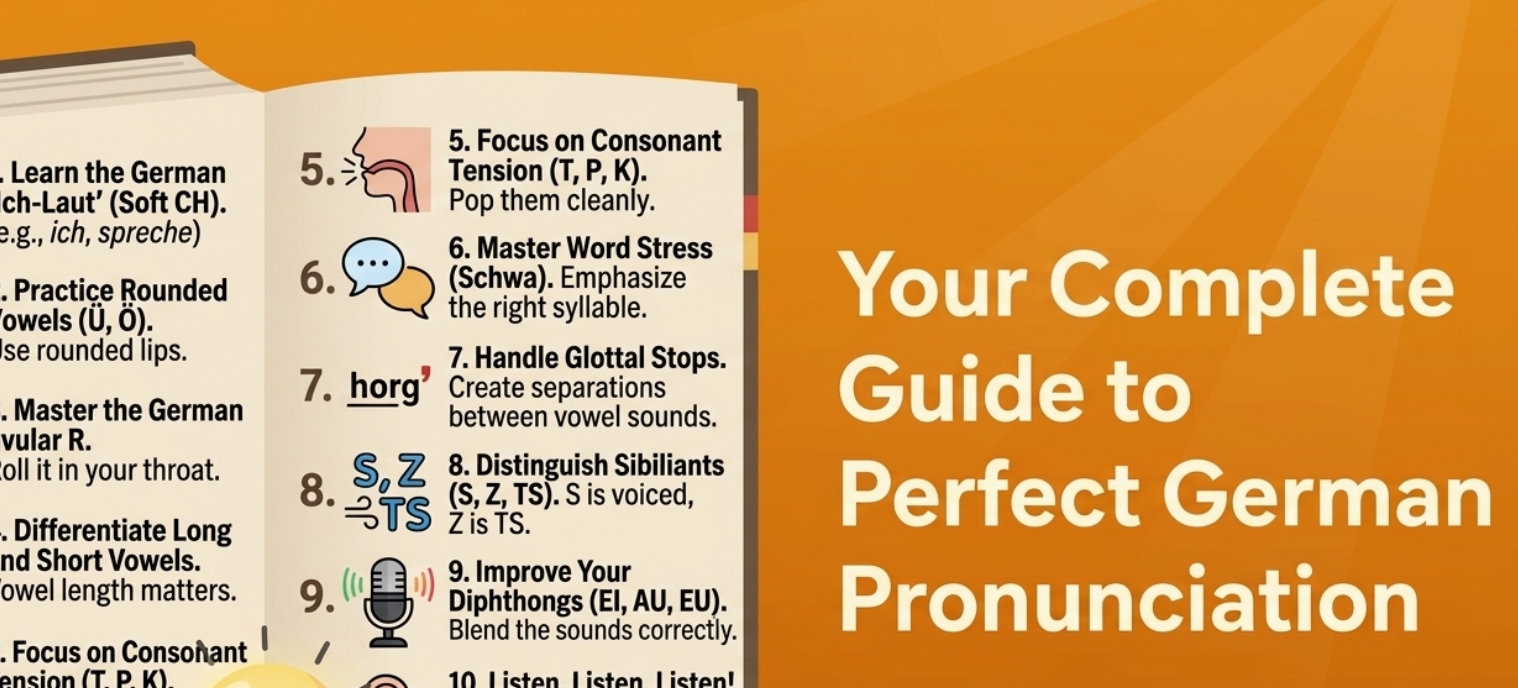
✔ Listen to native speakers
✔ Repeat words loudly
✔ Learn umlauts early
✔ Practice daily
✔ Use German songs and movies
✔ Read aloud every day
The more you hear the language, the faster your pronunciation improves.
Best Way for Beginners to Learn German Pronunciation
The best way to learn pronunciation is through:
-
Guided lessons
-
Speaking practice
-
Listening exercises
-
Real conversations
-
Structured courses
Beginners who follow a proper learning plan usually improve faster than self-study learners.
Also Read : German Greetings & Daily Phrases
Conclusion
German pronunciation may look difficult at first, but it becomes easy once you understand the basic rules. Since German is a phonetic language, beginners can learn to speak correctly with regular practice.
By learning the alphabet, vowel sounds, umlauts, and pronunciation rules, you can quickly start speaking German with confidence.
If you practice daily, German pronunciation can become one of the easiest parts of learning the language.