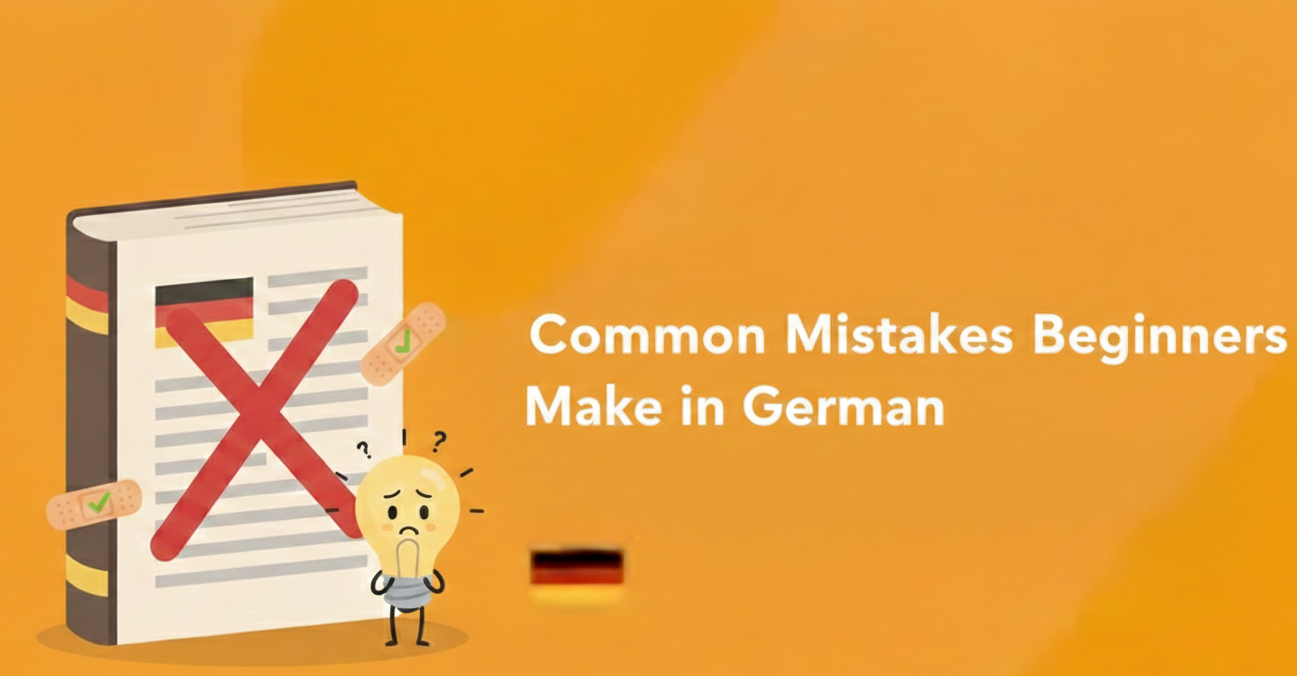
Common Mistakes Beginners Make in German (and How to Fix Them)
Learning German feels exciting at first — until strange grammar rules, long words, and unexpected pronunciations start showing up. Most beginners struggle not because German is “too hard,” but because they repeat a few predictable mistakes.
If you recognize these early, progress becomes much faster and far less frustrating.
1. Translating Directly from English
One of the biggest traps is trying to map English logic onto German.
German sentence structure works differently:
-
English: I am going to the market today.
-
German: Ich gehe heute zum Markt.
Word order, verb placement, and even emphasis shift.
Why this hurts:
Direct translation creates unnatural sentences and confusion with verb positioning.
Fix:
Think in German patterns, not English sentences. Learn structures instead of word-for-word equivalents.
Also Read : German Sentence Structure Explained
2. Ignoring Grammatical Gender
German nouns are not neutral. Every noun has a gender:
-
der (masculine)
-
die (feminine)
-
das (neuter)
Beginners often memorize vocabulary without articles:
❌ Buch
✅ das Buch
Why this hurts:
Gender affects articles, adjective endings, pronouns, and cases.
Fix:
Always learn nouns with their articles. Treat them as a single unit.
3. Avoiding Cases (Because They Look Scary)
German cases — nominative, accusative, dative, genitive — intimidate many learners.
So beginners either:
-
Ignore them
-
Guess randomly
-
Avoid complex sentences
Why this hurts:
Cases are foundational, not optional.
Fix:
Start simple:
-
Subject → Nominative
-
Direct object → Accusative
-
Indirect object → Dative
Build gradually instead of postponing forever.
4. Mispronouncing Sounds
German pronunciation is logical — but different.
Common issues:
-
ch sound (ich / ach)
-
ü / ö / ä
-
Rolling or soft r
Why this hurts:
Poor pronunciation becomes a habit that’s difficult to correct later.
Fix:
Listen early. Mimic native audio. Use resources like the Goethe-Institut or native speaker recordings.
5. Memorizing Words Without Context
Beginners often create endless vocabulary lists.
❌ Random isolated words
✅ Words inside sentences
Why this hurts:
Memory fades quickly without usage.
Fix:
Learn phrases and patterns:
-
Ich habe Hunger (I am hungry)
-
Es ist mir egal (I don’t care)
Context improves retention dramatically.
6. Being Afraid to Speak
Many learners delay speaking until they feel “perfect.”
That moment never comes.
Why this hurts:
German is a skill, not a theory subject.
Fix:
Speak early. Make mistakes. Fluency grows through usage, not silent studying.
7. Expecting Fast Results
German requires consistency. Beginners often quit because progress feels slow.
Reality check:
Even reaching conversational comfort typically aligns with CEFR levels like A2 or B1 — which take time.
Fix:
Measure progress in milestones, not perfection:
-
Understanding basic conversations
-
Forming sentences confidently
-
Following native content gradually
A Smarter Way to Learn German
Most beginner mistakes stem from one mindset problem:
👉 Treating German like a memorization subject instead of a system.
German rewards learners who:
✔ Learn patterns
✔ Accept mistakes
✔ Practice actively
✔ Focus on comprehension + speaking
Final Thought
Struggling in German isn’t a sign of failure — it’s a sign you’re learning something structured and precise.
Avoid these common pitfalls, and German suddenly feels less like a puzzle and more like a predictable framework.