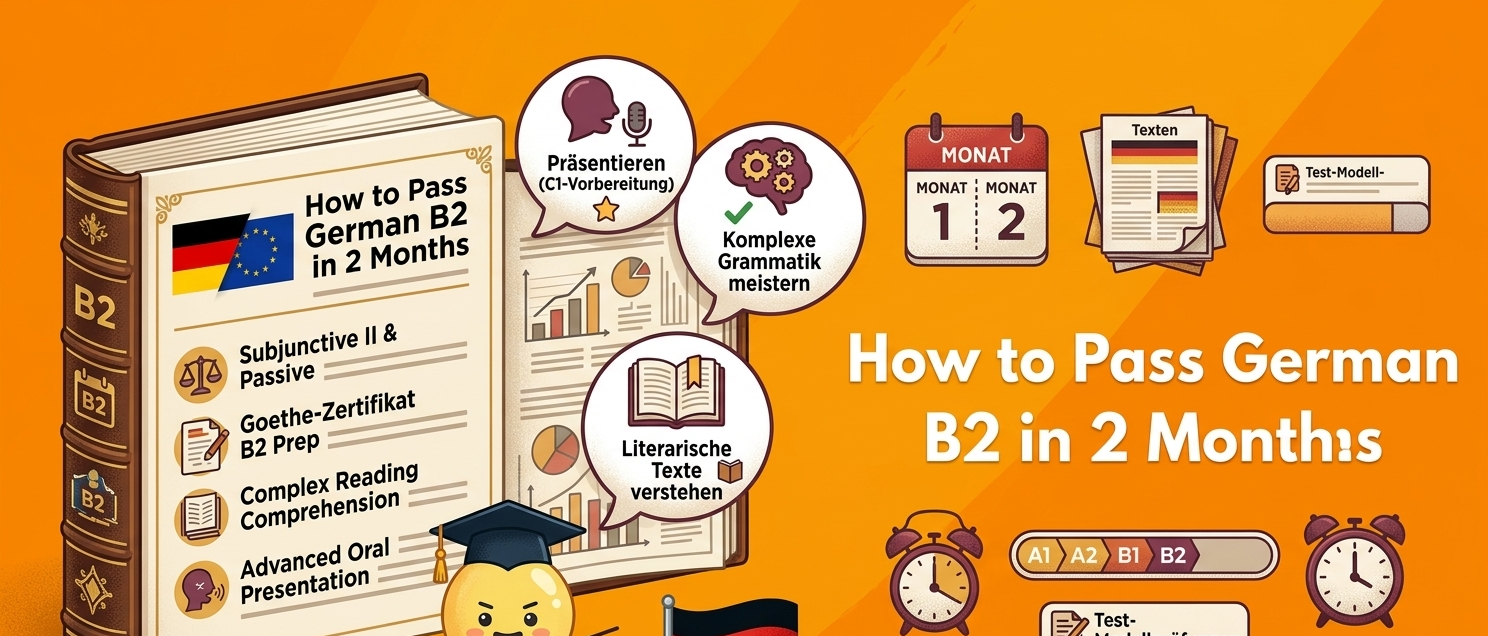
How to Pass German B2 in 2 Months: A Smart & Realistic Study Plan
Passing the German B2 exam within 2 months is challenging—but absolutely possible with the right strategy, daily discipline, and exam-focused preparation. This level tests not just grammar, but your ability to think, speak, and write confidently in German.
This article gives you a realistic 8-week plan, proven techniques, and common mistakes to avoid so you can crack B2 efficiently.
Is It Really Possible to Pass German B2 in 2 Months?
Yes—if you already have a strong B1 level.
You should already be able to:
-
Understand everyday conversations
-
Form correct sentences in past, present & future
-
Write short texts without translating word by word
If your B1 basics are weak, first spend 10–14 days revising B1 before jumping into B2.
Understanding the German B2 Exam Structure
Before preparing, you must understand what you’re preparing for.
Most B2 exams (Goethe / TELC / ÖSD) test:
-
Reading (Lesen) – Text understanding, opinions, details
-
Listening (Hören) – Conversations, interviews, discussions
-
Writing (Schreiben) – Formal emails, opinions, essays
-
Speaking (Sprechen) – Discussions, presentations, arguments
👉 B2 is not about perfection, it’s about clarity, structure, and confidence.
8-Week German B2 Study Plan (Daily 3–4 Hours)
Week 1–2: Strengthen Your B2 Foundation
Focus on core grammar + vocabulary.
Grammar to master:
-
Konjunktiv II (würde, hätte, wäre)
-
Passive voice
-
Relative clauses
-
Prepositions with cases
-
Word order in complex sentences
Vocabulary focus:
-
Education, work, environment, health, technology
-
Opinion phrases (Meiner Meinung nach, Einerseits–andererseits)
📌 Daily task:
-
1 grammar topic
-
30–40 new B2 words
-
1 short writing (80–100 words)
Week 3–4: Reading & Listening Like an Exam Candidate
Now switch from learning → applying.
Reading practice:
-
News articles (DW, Goethe sample tests)
-
Identify main idea, tone, and arguments
Listening practice:
-
German podcasts
-
Interviews & discussions
-
Focus on keywords, not every word
📌 Daily task:
-
1 reading test
-
1 listening test
-
Note new words in context
💡 Tip: Don’t pause audio repeatedly—train your real exam ears.
Week 5–6: Writing & Speaking – The Scoring Sections
This is where most students lose marks.
Writing (Schreiben)
Learn fixed structures:
-
Introduction → opinion → reasons → conclusion
-
Formal email formats
Practice:
-
1 full writing task every alternate day
-
Get feedback (teacher / AI / peer)
Speaking (Sprechen)
Practice:
-
Giving opinions
-
Agreeing & disagreeing politely
-
Speaking for 2–3 minutes without stopping
📌 Daily speaking drill:
-
Pick 1 topic
-
Record yourself
-
Improve clarity, not speed
Week 7: Full Mock Tests & Weak Area Fixing
This week is about exam simulation.
-
Take 3–4 full B2 mock tests
-
Time yourself strictly
-
Analyze mistakes
Fix:
-
Grammar errors you repeat
-
Weak vocabulary topics
-
Speaking hesitation points
Week 8: Revision & Confidence Building
Do NOT learn new topics now.
Focus on:
-
Templates for writing
-
Speaking phrases
-
Common exam vocabulary
-
Light listening & reading
💡 Sleep well, revise smart, stay calm.
Daily German B2 Study Routine (Simple & Effective)
-
45 min – Grammar + vocabulary
-
45 min – Reading or listening
-
45 min – Writing or speaking
-
30 min – Revision & mock practice
👉 Consistency beats long, irregular study sessions.
Common Mistakes That Make Students Fail B2
❌ Studying without mock tests
❌ Translating from English mentally
❌ Ignoring speaking practice
❌ Learning too many new words without context
❌ Panicking during the exam
Final Tips to Pass German B2 Faster
✅ Think in German
✅ Speak daily—even alone
✅ Focus on exam patterns
✅ Learn phrases, not single words
✅ Practice under time pressure
Final Words
Passing German B2 in 2 months is intense—but if you follow a structured plan, practice daily, and stay exam-focused, success is very achievable.
Remember: B2 is about communication, not perfection.
If you want, I can also help you with:
-
SEO-optimized meta description
-
B2 study timetable (PDF style)
-
Writing & speaking templates
-
Article H1–H3 structure for ranking